Principles of Corrosion Engineering and Corrosion Control

Highly illustrated, with worked examples and definitions, this one-stop guide covers basic corrosion principles, and more advanced information for postgraduate students and professionals.
 TABLE OF CONTENTS
 For corrosion to take place, the formation of a corrosion cell is essential. A corrosion cell is essentially comprised of the following four components (Fig. 2.1).
Anode
Cathode
Electrolyte
Metallic path.

Anode: One of the two dissimilar metal electrodes in an electrolytic cell, represented as the negative terminal of the cell. Electrons are released at the anode, which is the more reactive metal. Electrons are insoluble in aqueous solutions and they only move, through the wire connection into the cathode. For example, in a battery, zinc casing acts as the anode. Also in a Daniel cell, zinc is the anode as oxidation occurs on it and electrons are released (Fig. 2.2). Corrosion nomenclature is the opposite of electroplating nomenclature, where an anode is positive and the cathode is negative.
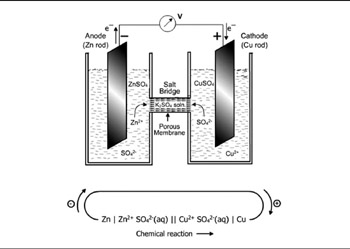
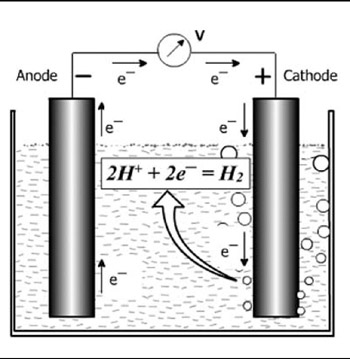
Cathode: One of the two electrodes in an electrolytic cell represented as a positive terminal of a cell. Reduction takes place at the cathode and electrons are consumed. Example, carbon electrode in a battery, copper electrode in a Daniel cell. Figure 2.3 shows the reduction of hydrogen ion. The electron is always a reducing agent.
Electrolyte: It is the electrically conductive solution (e.g. salt solution) that must be present for corrosion to occur. Note that pure water is a bad conductor of electricity. Positive electricity passes from anode to cathode through...