Principles of Corrosion Engineering and Corrosion Control

Highly illustrated, with worked examples and definitions, this one-stop guide covers basic corrosion principles, and more advanced information for postgraduate students and professionals.
 TABLE OF CONTENTS
 The classical electrochemical work conducted by Michael Faraday in the nineteenth century produced two laws published in 1833 and 1834 named after him. The two laws can be summarized below.
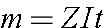
The mass of primary products formed at an electrode by electrolysis is directly proportional to the quantity of electricity passed. Thus:

where
I = current in amperes
t = time in seconds
m = mass of the primary product in grams
Z = constant of proportionality
(electrochemical equivalent). It is the mass of a substance liberated by 1 ampere-second of a current (1 coulomb).
The masses of different primary products formed by equal amounts of electricity are proportional to the ratio of molar mass to the number of electrons involved with a particular reaction:
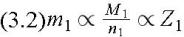
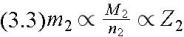
where
m 1, m 2 = masses of primary product in grams
M 1, M 2 = molar masses (g.mol 1)
n 1, n 2 = number of electrons Z 1, Z 2 = electrochemical equivalent.
Combining the first law and the second law, as in equation (3.1)
Substituting for Z, from equation (3.2) into (3.1)
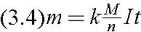
or
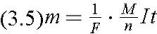
where F = Faraday's constant. It is the quantity of electricity required to deposit the ratio of mass to the valency of any substance and expressed in coulombs per mole (C...