Principles of Corrosion Engineering and Corrosion Control

Highly illustrated, with worked examples and definitions, this one-stop guide covers basic corrosion principles, and more advanced information for postgraduate students and professionals.
 TABLE OF CONTENTS
 It is a form of corrosion in which zinc is selectively attacked in zinc-containing alloys, like brasses. It mainly occurs in alloys containing less than 85% copper. De-alloying and selective leaching are broader terms which refer to the corrosion of one or more constituent of a solid solution alloy.
Dezincification is a form of de-alloying. As the phenomenon was first observed in brass in which zinc separated by dissolution from copper, the term dezincification is still used.
Ordinary brass consists of about 30% zinc and 70% copper. Dezincification can be observed by naked eyes, because the alloy changes in color from yellow to red.
Two types of dezincification are commonly observed:
Uniform type (layer type) (Fig. 4.9)
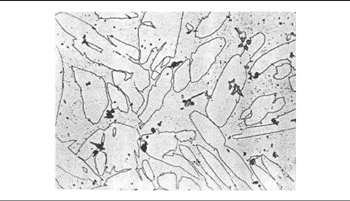
Figure 4.9: Dezincification of ?- ? brass (500 300)
Plug type (Fig. 4.10)
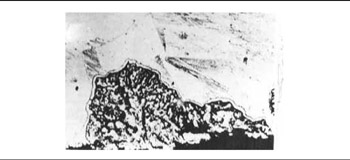
Figure 4.10: Dezincification plugs in 70-30 Brass exposed to NaCI. Evidence of two mechanisms operating simultaneously can be observed in the picture. (From Vernik, R.D. Jr. and Heiderbach, R.H. Jr. (1972). In Localised Corrosion, Cause of Metal Failure, STP 516, ASM. Reproduced by kind permission of ASM, Metals Park, Ohio, USA
The two types of attack can be observed in Fig. 4.9 and 4.10. In the uniform type of dezincification, the active area is leached out over a broad area of the surface and it is not localized to a certain point of the surface. On the other hand, the plug type of attack is localized, at a...