RFIC and MMIC Design and Technology

K. S. Ang and S. J. Nightingale
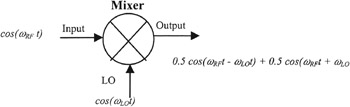
Mixers are key elements in nearly all RF and microwave communication receivers, transmitters and signal generators. They have the prime function of converting signals from one frequency to another, where other circuit functions like amplification, filtering, detection and transmission can be performed more effectively. Mathematically, this frequency translation can be performed by simply multiplying the input RF signal, at frequency ? RF, by another signal, at frequency ? LO, referred to as the local oscillator (LO):
| (7.1) | |
This is shown symbolically in Figure 7.1. The mixer output consists of the sum and difference frequencies of the input signal and the LO. In the case of down-conversion, the input is a high frequency RF signal and the desired output is the lower frequency IF signal, ? RF ? LO. The reverse applies in the case of up-conversion, where the input is a low frequency IF signal and the desired output is the higher frequency RF signal, ? RF + ? LO . In each case, the desired signal is usually obtained by filtering.
Practically, eqn. (7.1) can represent a circuit equation in which a current waveform i( t) is generated by the product of the signal voltage, v RF( t), and a conductance, g( t):
| (7.2) | |
where the conductance has a time-varying behaviour which varies at the rate...