RFIC and MMIC Design and Technology

Chapter 9: Phase Shifters

S. Lucyszyn and J. S. Joshi

9.1 Introduction

A phase shifter is a control device found in many microwave communication, radar and measurement systems. This chapter describes many of the design techniques for MMIC phase shifters, implemented under either analogue or digital control. In order to understand the subtle differences between the two main generic types of phase shifter, both the true phase shifter and the true delay line must first be defined.

A true phase shifter can be defined as a control device that has a flat group delay frequency response within its defined bandwidth of operation, the level of which does not change as the insertion phase is varied. Its two characteristic features are:

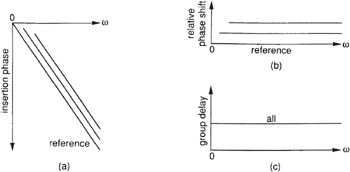
  1. a flat relative phase shift frequency response, at all levels of relative phase shift

  2. constant group delay, resulting in no change in the timing of an input RF pulse envelope.

The frequency characteristics of a true phase shifter are illustrated in Figure 9.1. True phase shifters can be employed in multiple space diversity receiver-combiners for aligning RF signals within a pulse envelope without changing the timing of the pulse edges. However, they should not be employed in wideband beam-forming networks for large aperture phased-array antennas, in order to avoid the effects of 'phase squinting' and 'pulse stretching'.


Figure 9.1: Frequency characteristics of a true phase shifter (a) insertion phase, (b) relative phase shift and (c) group delay

A time shifter can be defined as a control device that has a flat group delay frequency...

UNLIMITED FREE
ACCESS
TO THE WORLD'S BEST IDEAS

SUBMIT
Already a GlobalSpec user? Log in.

This is embarrasing...

An error occurred while processing the form. Please try again in a few minutes.

Customize Your GlobalSpec Experience

Category: RF Waveguide Phase Shifters
Finish!
Privacy Policy

This is embarrasing...

An error occurred while processing the form. Please try again in a few minutes.