RFIC and MMIC Design and Technology

7.8: Resistive FET Mixers

7.8 Resistive FET Mixers

As discussed in Section 7.1, the use of non-linear elements for frequency mixing results in spurious mixing products and intermodulation. Instead, if a voltage- or current-controlled circuit element, whose transfer function varies linearly as in eqn. (7.4), is employed, a mixer without any spurious responses can be realised. A circuit element that approximates this behaviour does exist: it is the channel conductance of an unbiased FET. A mixer based on the unbiased FET is referred to as the resistive FET mixer and was first described by Maas [110].

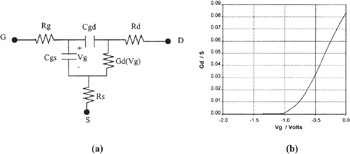
Figure 7.39 shows the equivalent circuit of the FET at low drain bias voltages. Also shown is the variation of channel conductance, G d, with the gate bias, V gs, for a typical PHEMT device. The channel conductance varies relatively linearly over a specific range of gate voltage. This is in contrast to the strongly non-linear active FET transconductance and the Schottky diode junction resistance, which varies exponentially with applied voltage. Thus, when the LO is applied to the gate, a time-varying conductance with very low LO harmonics is generated. This results in a mixer with low spurious mixing products. Other advantages include low DC power consumption and natural separation of LO and RF/IF ports. In FET-based monolithic circuits, the resistive FET is often a better option than implementing Schottky diodes using derivatives of the FET structure. Resistive mixers have been demonstrated up to F-band using InAlAs/GaInAs/InP HEMTs [123].


Figure 7.39: The resistive FET (a)...

UNLIMITED FREE
ACCESS
TO THE WORLD'S BEST IDEAS

SUBMIT
Already a GlobalSpec user? Log in.

This is embarrasing...

An error occurred while processing the form. Please try again in a few minutes.

Customize Your GlobalSpec Experience

Category: RF Mixers
Finish!
Privacy Policy

This is embarrasing...

An error occurred while processing the form. Please try again in a few minutes.