RFIC and MMIC Design and Technology

D. S. McPherson and C. E. Chrisostomidis
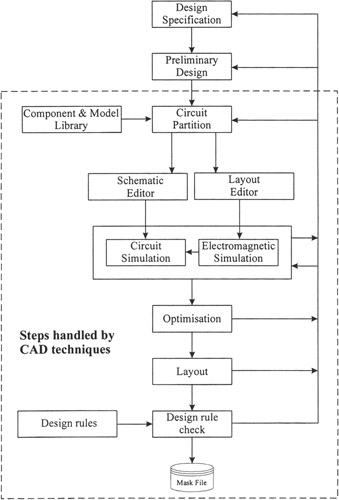
CAD tech1niques are now an integral part of the MMIC design cycle. Consequently, the architecture of most commercially available software products is based on a universal sequence of interrelated steps. Referring to Figure 4.1, the procedure begins with a set of specifications that must be achieved by the design. Using experience, reference material and theoretical principles, the designer interprets the specifications and proposes a preliminary design topology.
The preliminary design is then represented in the CAD package using library components and models. In the first design iteration, it is often prudent to simplify the circuit representation by using idealised components. This allows the designer to ascertain the worth of the proposed topology quickly. If the idealised design does not exceed the required specifications, it is almost certain that a practical realisation of the topology will fail. Whether in the first or subsequent design iterations, the cycle proceeds to simulation, using circuit and electromagnetic (EM) simulators. There are no clearly defined procedures as to when and how to use these. In some instances, there is a strong mutual dependence between the results of the two classes of simulators. As a result, the simulations are carried out concurrently. In other cases, there are distinctly separable portions of the MMIC that are more amenable to one class of simulation than another, where simulations can be carried out sequentially.
It is seldom the case in MMIC design that a...