A. General Kinetics
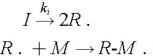
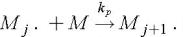
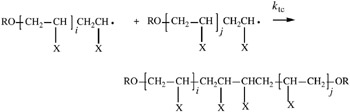
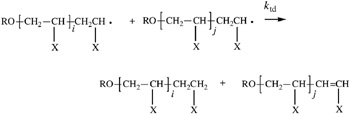
The general kinetics for this mechanism [26] involve the usual three primary steps of any chain reaction, i.e., initiation, propagation, and termination, as shown below. Initiation generally occurs by the formation of free radicals through the homolytic dissociation of weak bonds (e.g., in peroxides or azo compounds) or by irradiation. Termination reactions for vinyl polymers can occur either by combination (coupling), by disproportionation, or by a combination of both reactions (discussed next).
Initiation
Propagation
Termination
where I = initiator, M = monomer, R = initial free radical, and M j . = propagating free radical.
Combination
Disproportionation
This sequence of steps then leads to the following simple kinetic treatment [26]:
Assuming a steady-state condition where the rate of formation of radicals is equal to their rate of disappearance, i.e., R i = R t,
and
Equation (15) thus illustrates the dependency of the overall rate of polymerization on the concentrations of initiator and monomer. The half-power dependence of the rate on the initiator concentration appears to be a universal feature of the free radical mechanism and has been used as a diagnostic test for the operation of this mechanism.
Another important aspect of free radical polymerization is the dependency of the number-average degree of polymerization on initiator and monomer concentrations as shown in Eq. (16). Comparison with Eq. (15) shows that increasing the rate of initiation, by increasing the initiator concentration, increases the rate of polymerization...

 TABLE OF CONTENTS