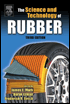
Science and Technology of Rubber, Third Edition
A. F. HALASA
Research and Development
The Goodyear Tire & Rubber Company
Akron, Ohio
JEAN MARIE MASSIE
Lexmark International
Lexington, Kentucky
R. J. CERESA
Chemistry and Polymer Technology Department
Polytechnic of South Bank
London, England
The terms rubber and elastomer embrace those polymers which have useful rubberlike, highly elastic properties at ambient temperatures; however, many polymers which are nonrubbers by themselves can be chemically modified to a relatively small extent to give products with very useful viscoelastic properties. For example, the introduction of a few chlorine atoms and sulfoxide groups into polyethylene changes the macromolecules so that they no longer tend to form crystalline regions, but become elastomers over a wide temperature range. These groups also allow vulcanization so that reversibly deforming, solvent-resistant products can be formulated. On the other hand, starting with a conventional rubber, it is possible, by means of chemical reactions, to convert the macromolecular chains so that they lose their viscoelasticity and become thermoplastic at ambient temperatures (e.g., the cyclization of polyisoprenes). Quite apart from the question of the temperature at which observations are carried out, the borderline between the viscoelastic and the plastic states is a relatively ill-defined one. The common factor of rubbers and plastics is, of course, their macromolecular nature. Now that we have a better understanding of their structure at a molecular level (not forgetting rubber-modified plastics and plasticized rubbers), we are able to say that, with some exceptions, a modification that can be carried out on...