A. Mechanism and Kinetics
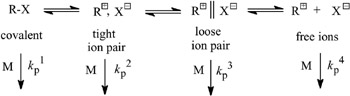
In these chain addition reactions, the active species is cationic in nature, initiated by strong acids, either of the protic or Lewis variety [21, 104 111]. Since most of these ionic polymerizations are carried out in nonaqueous solvents with low dielectric constants [109], it is unlikely that the active species is a free ion, analogous to a free radical. A multiplicity of active species may be involved as propagating species as shown below by the spectrum of cationic species, one or more of which may be involved as active propagating species, especially in more polar solvents [112]. Unfortunately, very little information
is available about the exact nature of the propagating species in cationic systems. This is mainly due to the inherent experimental difficulties, caused by high reactivity and sensitivity to impurities, especially to traces of water.
The most common initiators of cationic polymerization are Lewis acids, such as AlCl 3,BF 3, SnCl 4, and TiCl 4, although strong protic acids such as H 2SO 4 may also be used. Cationic polymerization is restricted to vinyl monomers with electron-donating or electron-delocalizing substituents, e.g., isobutylene, vinyl alkyl ethers, vinyl amines, styrene, and other conjugated hydrocarbons. These polymerizations are characterized by rapid rates at very low temperatures, e.g., isobutylene is polymerized almost instantaneously at ?100 C by AlCl 3. The presence of a hydrogen donor, such as water or a protic acid, as a cocatalyst, is usually...

 TABLE OF CONTENTS