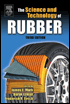
Science and Technology of Rubber, Third Edition
Chapter 10: Strength of Elastomers

A. N. GENT
The University of Akron
Akron, Ohio

I. INTRODUCTION

Fracture is a highly selective process: only a small number of those molecules making up a test piece or a component actually undergo rupture; the great majority are not affected. For example, of the 10 26 chain molecules per cubic meter in a typical elastomer, only those crossing the fracture plane, about 10 18/m 2, will definitely be broken. Moreover, these will not all break simultaneously but successively as the fracture propagates across the specimen at a finite speed.

Thus, the first questions posed in studying the strength of elastomers (and other materials as well) are: where and under what conditions does fracture begin? Also, what laws govern the growth of a crack once it has been initiated? This chapter seeks to answer such questions, first in a general way and then with particular reference to important modes of failure of elastomers in service. It does not deal with the rather complex problem of the strength of composite structures, such as a pneumatic tire, which involves failure of adhesive bonds at interfaces between the components as well as fracture of the components themselves.

We consider first the initiation of fracture from flaws or points of weakness, where the applied stresses are magnified greatly. The rate of development of cracks after initiation is treated next. Naturally, this depends on the local stress levels but also on the way in which these stresses vary with time. For ...

UNLIMITED FREE
ACCESS
TO THE WORLD'S BEST IDEAS

SUBMIT
Already a GlobalSpec user? Log in.

This is embarrasing...

An error occurred while processing the form. Please try again in a few minutes.

Customize Your GlobalSpec Experience

Category: Polymers and Plastic Resins
Finish!
Privacy Policy

This is embarrasing...

An error occurred while processing the form. Please try again in a few minutes.