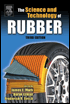
Science and Technology of Rubber, Third Edition
BURAK ERMAN
Department of Chemical and Biological Engineering
Koc University
Rumelifeneri Yolu, Istanbul, Turkey
JAMES E. MARK
Department of Chemistry
The University of Cincinnati
Cincinnati, Ohio
Rubberlike materials consist of relatively long polymeric chains having a high degree of flexibility and mobility, which are joined into a network structure. The requirement of flexibility and mobility is associated with the very high deformability. As a result of an externally imposed stress, the long chains may alter their configurations, an adjustment which takes place relatively rapidly because of the high chain mobility.The requirement of having the chains linked into a network structure is associated with solidlike features, where the chains are prevented from flowing relative to each other under external stresses. As a result, a typical rubber may be stretched up to about 10 times its original length. On removal of the external force,it rapidly recovers its original dimensions,with essentially no residual or nonrecoverable strain. As a result of these unique mechanical properties, rubbers find important usage ranging from automobile tires to heart valves, gaskets in jet planes, and space vehicles.
In ordinary solids such as crystalline or amorphous glassy materials, an externally applied force changes the distance between neighboring atoms, resulting in interatomic or intermolecular forces. In these materials, the distance between two atoms should only be altered by no more than a fraction of an angstrom if the deformation is to be recoverable. At higher deformations, the atoms slide past each other, and either flow takes place or...