Sea Clutter: Scattering, the K Distribution and Radar Performance

3.3: EM scattering from the sea at high grazing angles

3.3 EM scattering from the sea at high grazing angles

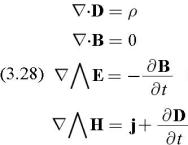
Given this specification of the sea surface, we must now capture its interaction with the incident microwave radiation. The behaviour of this electro magnetic field is governed


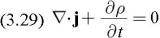
Here E and H are the electric and magnetic field in tensities, D is the electric displacement and B is the magnetic induction; ? and j are charge and current densities satisfying the conservation relation


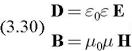
The field intensities are related to the associated displacement and induction through constitutive relations


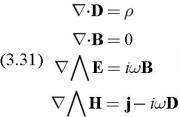
If harmonic time dependence exp( ? i ?t) is assumed in 3.28 the equations become


We are interested in the free space above the sea (where ? = ? = 1) and the sea itself, which is an imperfect electrical conductor. We can describe the finite electrical conductivity of sea water by setting ? = 1 and taking ? to have a large imaginary part and a real part greater than unity. This allows us to suppress the j in equation (3.31) as it is accounted for by the imaginary part of ?. At the sea surface the fields satisfy boundary conditions that require that the tangential components of E and B and the normal components of E and D are continuous.

Calculation of the scattered field from the sea surface for a particular radar illumination may be done in the time domain by using equation...

UNLIMITED FREE
ACCESS
TO THE WORLD'S BEST IDEAS

SUBMIT
Already a GlobalSpec user? Log in.

This is embarrasing...

An error occurred while processing the form. Please try again in a few minutes.

Customize Your GlobalSpec Experience

Category: Remotely Operated Underwater Vehicles (ROVs)
Finish!
Privacy Policy

This is embarrasing...

An error occurred while processing the form. Please try again in a few minutes.