Sea Clutter: Scattering, the K Distribution and Radar Performance
Having developed some understanding of the scattering process at low grazing angles, it is worth while returning to the problem of imaging ocean currents. In Section 3.4 we described the process where by an ocean current field changes the radar backscatter characteristics of the sea surface and produces a distinct signature on radar images at high grazing angles. Recently, Reference [36] reporteda set of experiments where it was shown that these signatures increase in magnitude as the grazing angle decreases to the low grazing angle regime (i.e. less than 10 ).
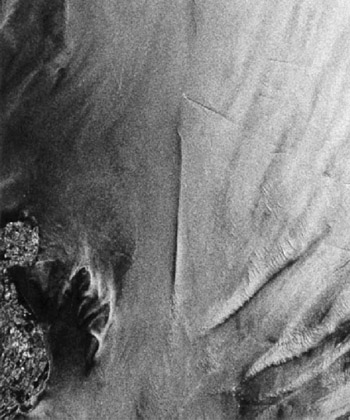
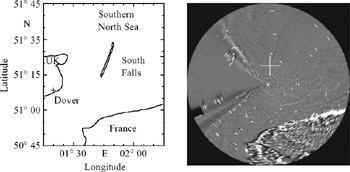
The paper describes 12 airborne radar data collections: nine using the Enhanced Surveillance Radar (ESR), which is a synthetic aperture radar (SAR); and three using Searchwater, which is a scanning radar, on the Nimdod MR2. Both radar systems operatedat I band. In common with the analysis presented in Section 3.4, the experiments investigated the effects of tidal flows over the South Falls sandbank. A radar image of the area, as seen from the ERS2 satellite, is shown in Figure 3.35. Example results from the low grazing angle radar systems are shown in Figures 3.36 and 3.37.