Sea Clutter: Scattering, the K Distribution and Radar Performance

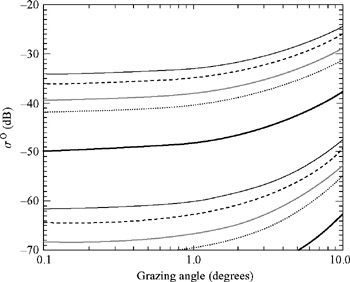
As we described at the beginning of Section 3.6, the composite model is unable to reproduce the observed sea clutter average backscatter trends at low grazing angles. The GIT empirical model [27], as presented in Figure 3.16, differs from the composite model in that it has less polarisation dependence, more variation with sea state, and a different limiting behaviour at small grazing angle.
The lack of variation with sea-state may be overcome by improving the model of the sea surface, and in corporating the change of wave spectrum in the gravity-capillary wave number regime, which was discovered and modelled by J hne and Riemer [3]. This is discussed in Section 3.2, where the Elfouhaily spectrum [4]is proposedas a means to incorporate these effects. With this modifiedwave spectrum the variation of ? 0 with sea-state is more realistic as shown in Figure 3.31.
As shown in Section 3.6 further improvements to the composite model may be made through the introduction of shadowing and multipath interference. Shadowing reduces the amount of sea surface that is illuminated. At 10 grazing angle shadowing is negligible; below 10 we introduce an attenuation of 4 dB per decade. Following Katzin's explanation for the critical angle effect