Sea Clutter: Scattering, the K Distribution and Radar Performance

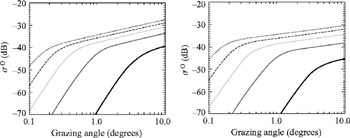
The characteristics of sea clutter at low grazing angles have caused problems to radar designers since the discovery of radar. The description of clutter has been essentially empirical and so it has not been possible to use the data effectively for remote sensing. The scattering models described thus far in this chapter are ineffective at evaluating the average normalised RCS, ? 0, as shown in Figures 3.16 and 3.17. Here a comparison is made of an empirical model, the Georgia Tech (GIT) model [27] (which is described in detail in Chapter 8), and the composite model as described above. The sea surface wave spectrum is the Pierson-Moskowitz formula equation (3.1).
There are three main differences between the experimental data (GIT model, Figure 3.16) and the composite scattering model (Figure 3.17). The composite model:
has much too large a difference between ? 0