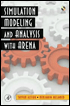
Simulation Modeling and Analysis with ARENA
Chapter 2: Discrete Event Simulation

The majority of modern computer simulation tools (simulators) implement a paradigm, called discrete-event simulation (DES). This paradigm is so general and powerful that it provides an implementation framework for most simulation languages, regardless of the user worldview supported by them. Because this paradigm is so pervasive, we will review and explain in this chapter its working in some detail.

2.1 ELEMENTS OF DISCRETE EVENT SIMULATION

In the DES paradigm, the simulation model possesses a state S (possibly vector-valued) at any point in time. A system state is a set of data that captures the salient variables of the system and allows us to describe system evolution over time. In a computer simulation program, the state is stored in one or more program variables that represent various data structures (e.g., the number of customers in a queue, or their exact sequence in the queue). Thus, the state can be defined in various ways, depending on particular modeling needs, and the requisite level of detail is incorporated into the model. As an example, consider a machine, fed by a raw-material storage of jobs. A "coarse" state of the system is the number jobs in the storage; note, however, that this state definition does not permit the computation of waiting times, because the identity of individual jobs is not maintained. On the other hand, the more "refined" state consisting of customer identities in a queue and associated data (such as customer arrival times) does permit the computation of waiting times.

UNLIMITED FREE
ACCESS
TO THE WORLD'S BEST IDEAS

SUBMIT
Already a GlobalSpec user? Log in.

This is embarrasing...

An error occurred while processing the form. Please try again in a few minutes.

Customize Your GlobalSpec Experience

Category: Network Simulation Software
Finish!
Privacy Policy

This is embarrasing...

An error occurred while processing the form. Please try again in a few minutes.