Simulation Modeling and Analysis with ARENA
This section extends the production/inventory system studied in Section 12.1 by adding several echelons to it. Specifically, this example studies a four-echelon supply chain consisting of a supplier, manufacturing plant, distribution center, and retailer. The system uses so-called installation stock policies (replenishment policies based only on local information at the supplied installation). Note that such policies utilize only Inventory position data (inventory on hand, outstanding orders, and backorders). In contrast, so-called echelon stock policies require additional information in the form of Inventory positions at the current installation, as well as at all downstream echelons.
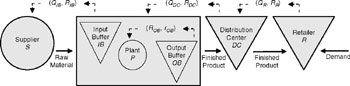
Consider a single-product, multiechelon supply chain consisting of a retailer (R), distribution center (DC), manufacturing plant (P), and supplier (S). The manufacturing plant interacts with two buffers: an input buffer (IB) storing incoming raw material, and an output buffer (OB) storing outgoing finished product. The system is depicted schematically in Figure 12.40.
The retailer faces a customer demand stream, and to manage inventory, it uses a continuous-review (Q R, R R) control policy, based only on information at the retailer. Recall that under this policy, a replenishment of quantity Q R is ordered from the distribution center whenever the Inventory position (inventory on-hand plus outstanding orders minus backorders) down-crosses level R R. If the distribution center has sufficient Inventory on hand, then the order lead time consists only of transportation delay. Otherwise, it...