Simulation Modeling and Analysis with ARENA
This section presents a generic model of a production/inventory system (Altiok [1997]) consisting of a production facility that is subject to failure, which supplies a warehouse with one type of product. This generic model illustrates how an inventory control policy regulates the flow of product between production and inventory facilities.
Consider a production/inventory system where the production process (e.g., packaging) is comprised of three stages:
Filling each container unit (e.g., bottles)
Sealing each unit
Placing labels on each unit
For modeling purposes, the processing times of individual stages are combined into a single-stage processing time.
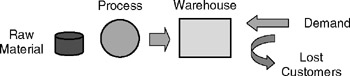
Figure 12.1 depicts a schematic diagram of the system. A raw-material storage source feeds the production process, and finished product units (units, for short) are stored in a warehouse. Customers arrive at the warehouse with product requests (demands), and if a request cannot be fully satisfied by on-hand inventory, the unsatisfied portion represents lost sale.
The following assumptions are made:
There is always sufficient raw material in storage, so the process never starves.
Product processing is carried out in lots of five units, and finished lots are placed in the warehouse. Lot processing time is uniformly distributed between 10 and 20 minutes.
The production process experiences random failures that may occur at any point in time (see Chapter 11 for more details). Times between failures are iid exponentially distributed with a mean of 200 minutes, while repair times are iid normally...