Simulation Modeling and Analysis with ARENA
Manufacturing facilities in a host of industrial sectors are structured as a series of production stages. Jobs in a variety of forms are transferred from one stage to another to be processed in a prescribed order; these jobs eventually leave the system as finished or semifinished products. Such systems are referred to as production lines.
The flexibility afforded by computer-controlled machinery enables production lines to handle a broad range of operations. Various operations permit the deployment of a sequence of intelligent workstations on the shop floor for processing or assembling various products. This chapter discusses simulation modeling of workstation sequences in the production line context.
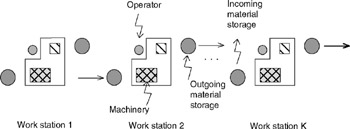
Consider the representation of a generic manufacturing facility depicted in a rather abstract form in Figure 11.1. The manufacturing facility is a production line composed of manufacturing stages consisting of workstations with intervening buffers to hold product flowing along the line. Each workstation contains one or more machines, one or more operators (possibly robots), and a work-in-process ( WIP) buffer. Upon process completion at a workstation, departing jobs join the WIP buffer at the next workstation, provided that space is available; otherwise, such jobs are typically held at the current workstation until space becomes available in the next buffer.
Many practical models may be formulated as variations on the generic production line of Figure 11.1, or with additional wrinkles. For example, a model may call for one or more repetitions of a...