Space: the Fragile Frontier

The first stage of lunar exploration involved the crude technique of launching hardware to impact the Moon, an occupation in which success was measured by how close the spacecraft got to the target. It was only later that the more advanced techniques for orbiting and landing were perfected.
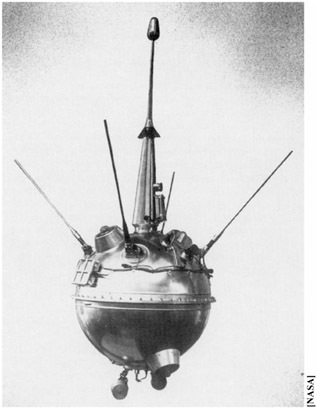
The first spacecraft to hit the Moon, on 13 September 1959, was the Soviet Union's Luna 2 (Fig. 46). It carried a 26-kg sphere, which, according to one contemporary account, disintegrated on impact, scattering tiny medallions imprinted with Russia's hammer-and-sickle emblem over the surface of the Moon.2 In fact, no one really knows what happened to the spacecraft, the sphere, and the rocket upper stage that carried them there. And we shall not know conclusively until the impact area is located and imaged at high resolution, or a landing party investigates the crater(s) produced by the impact(s). Depending on the velocity of the hardware and the constitution of the surface, the force of the impact could have buried the sphere and its medallions under several meters of crust, fused them together in an unrecognizable mass, or spread them in a fountain of material across the surface.
In the same way that we have limited information on the debris created in orbit around the Earth, we have an incomplete knowledge of the debris created by spacecraft impacts on the lunar surface. And if our knowledge of the Moon's near...