Space: the Fragile Frontier

But why is all this effort regarding planetary protection so important when some would have us believe that a form of interplanetary cross-pollination has been going on for millennia? The evidence for this comes from meteorites found on Earth but shown to have the constituents or isotope ratios of other planetary bodies.
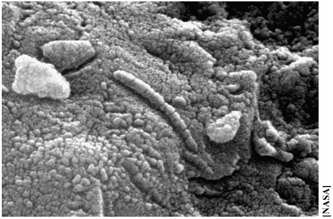
The most famous example is the so-called Martian meteorite, found in the Allan Hills region of Antarctica and designated ALH84001. In 1996, NASA announced that it appeared to contain fossilized life forms, thereby suggesting that there was once life on Mars (Fig. 62). Less well known is the lunar meteorite designated ALH81005, which, among others, is believed to have reached Antarctica from the Moon.
We have also been told that living organisms could have been brought to Earth by meteorites, and that flu and other pandemics might have been delivered by comets.36 ,37 If true, these are natural events over which mankind has no control. However, knowingly delivering our bugs and diseases to another planetary body is quite another matter and should be avoided. Apart from anything else, one never knows when we might unwittingly bring back a radiation-mutated version of a terrestrial pathogenic virus, to which we have no immunity.
A less speculative rationale for planetary protection is biological science's search for the "second data point,"38 a second place in the universe where life exists. The ramifications...