Space: the Fragile Frontier

Lunar Orbital Debris

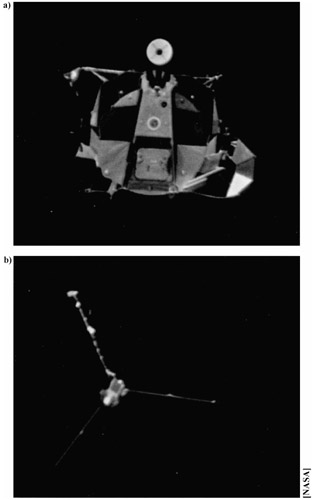
The Soviet Union's Luna 10 spacecraft and its propulsion unit were the first man-made objects to enter lunar orbit, on 3 April 1966. They were followed over the next few years by other Luna spacecraft (some of which were separated from their propulsion units), the Lunar Orbiters (which were all removed from orbit), and a number of Explorer spacecraft. In addition, the Apollo 15 and 16 missions released small (approximately 36-kg) subsatel-lites into lunar orbit, both of which decayed and fell to the surface within two years (Fig. 51).


Figure 51: Apollo lunar module ascent stage and sub-satellite, two examples of spacecraft that were deorbited onto the lunar surface.

As of mid-2005, less than 50 man-made objects had been placed in lunar orbit. At least 34 have either crashed onto the Moon or been maneuvered out of lunar orbit (24 and 10, respectively).4 Several of the remaining spacecraft and propulsion units are also believed to have reached the surface, but the complex lunar gravity field and the influence of the Earth make reliable predictions difficult. Although, ostensibly, the number of satellites in lunar orbit today is small, experience with Earth's orbital population gives cause for future concern.

First, there is the possibility of explosion and fragmentation as a result of the stored energy of residual propellant or battery constituents. This could produce clouds of debris that could damage other satellites and ultimately lead to the type of cascade problem discussed in the preceding chapter for low Earth...

UNLIMITED FREE
ACCESS
TO THE WORLD'S BEST IDEAS

SUBMIT
Already a GlobalSpec user? Log in.

This is embarrasing...

An error occurred while processing the form. Please try again in a few minutes.

Customize Your GlobalSpec Experience

Category: Satellites
Finish!
Privacy Policy

This is embarrasing...

An error occurred while processing the form. Please try again in a few minutes.