Space: the Fragile Frontier

Policy Refinement

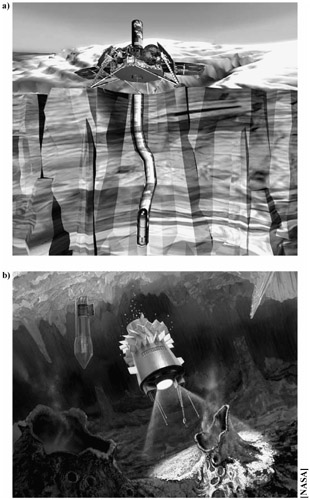
In 2002, the refinement of COSPAR policy was addressed at a joint COSPAR/IAU (International Astronomical Union) workshop on planetary protection, which considered among other things the potential forward contamination of Europa and Mars (Fig. 61).


Figure 61: Protection for Mars and the Jovian moon Europa is uppermost in the planetary protection regime. Concepts for a) a "cryobot" mission to probe Martian polar ice and b) a "hydrobot" to explore an ice-covered ocean on Europa. A cryobot would move by melting the ice ahead of it and allowing it to refreeze behind.

Protection for Europa is based on evidence that an ocean of liquid water might exist beneath the icy crust. Noting that terrestrial life has been shown to adapt to "extreme conditions, such as heat, cold, pressure, salinity, acidity, dryness, and high radiation levels as well as combinations of them," the workshop concluded that an organism from Earth could "colonize the entire subsurface via the ocean connection." Put simply, a single impact of a contaminated spacecraft could affect the entire Moon.

The workshop's recommendations included applying planetary protection requirements to future orbiters as well as landers, because an orbiter would have a significant probability of impacting the surface eventually.

The mere existence of so-called "extremophiles" on Earth encourages the belief that life could exist in what we humans might consider less than comfortable environments elsewhere in the solar system. Specifically, the notion that life might exist on Mars, despite Viking's negative results, was encouraged by research conducted in...

UNLIMITED FREE
ACCESS
TO THE WORLD'S BEST IDEAS

SUBMIT
Already a GlobalSpec user? Log in.

This is embarrasing...

An error occurred while processing the form. Please try again in a few minutes.

Customize Your GlobalSpec Experience

Category: Augers
Finish!
Privacy Policy

This is embarrasing...

An error occurred while processing the form. Please try again in a few minutes.