Space: the Fragile Frontier

Other Planetary Bodies

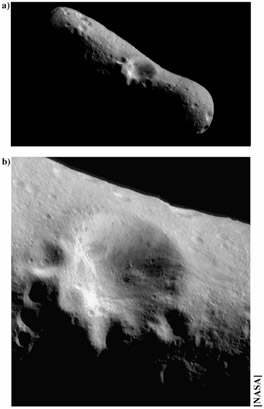
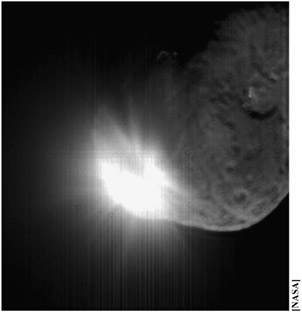
Of course, the scientific exploration of the solar system does not end with the Moon. Spacecraft have successfully entered orbit around Mars, Venus, Jupiter, and Saturn, whereas others have soft landed on Mars, Venus, and a number of lesser bodies. The first in the latter category was NEAR-Shoemaker's landing on the asteroid Eros in 2001 (Fig. 53), while other missions include the landing of Muses-C/Hayabusa on asteroid Itokawa in 2005 and that planned for Rosetta's Philae lander on Comet Churyumov-Gerasimenko in 2014. A somewhat less benign encounter was the aim of the aptly named Deep Impact, which fired a penetrator into Comet Tempel-1 on 4 July 2005 (Fig. 54).


Figure 53: The asteroid Eros is among the other solar system bodies visited by spacecraft (NEAR-Shoemaker landed there in 2001).

Figure 54: America celebrated the 4th of July 2005 by smashing a 370 kg, washing-machine-sized impactor into Comet Tempel-1; this early image from the Deep Impact spacecraft shows the resulting explosion.

As with the lunar landings, it is hard to characterize the successful landing missions, or even the penetrator probes, as polluting or degrading the celestial surfaces they are designed to investigate. In fact, these unmanned missions are likely to have a far less damaging effect than a manned mission, albeit with a more restricted scientific return. And one could hardly complain that the intentional injection of the Galileo entry probe into Jupiter's atmosphere would have a significant effect on that giant planet.

However, not all planetary spacecraft...

UNLIMITED FREE
ACCESS
TO THE WORLD'S BEST IDEAS

SUBMIT
Already a GlobalSpec user? Log in.

This is embarrasing...

An error occurred while processing the form. Please try again in a few minutes.

Customize Your GlobalSpec Experience

Category: Drilling and Tapping End Effectors
Finish!
Privacy Policy

This is embarrasing...

An error occurred while processing the form. Please try again in a few minutes.