Spacecraft Thermal Control Handbook, Volume II-Cryogenics
Although spacecraft with components that must be cooled to cryogenic temperatures of 2 to 150 K have been flown since the 1960s, recent years have seen a substantial growth in the emerging number of programs that include such spacecraft to service scientific, military, and weather observation missions. For example, the cooling of optics and detectors to reduce signal noise in infrared (IR) telescopes and the reduction of boil-off during long-term on-orbit storage of cryogenic fluids for propulsion systems and laser weapons are two of the principal applications of cryogenic cooling technologies for both today and the near future. A number of technologies can provide the cooling required for these and other applications; the choice depends on the desired temperature level, the amount of heat to be removed at that temperature, and the required operating life.
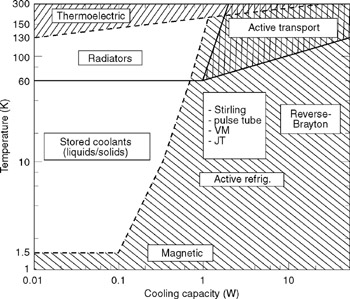
The graph in Fig. 1.1 gives an overview of which technologies are usually employed in each temperature/heat-load regime. (It assumes normal spacecraft mission durations on the order of one year or longer.) It was constructed by plotting data points from more than 60 systems that either have been fabricated and flown, have been tested, or have had a preliminary design proposed.
Radiators can be used, theoretically, down to about 60 K under ideal conditions. However, below about 100 K, their rejection capability falls dramatically because of the T 4 nature of radiation heat transfer, and their overall feasibility is highly dependent...