Spacecraft Thermal Control Handbook, Volume II-Cryogenics

[*] [*]
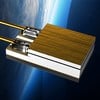
The flexible conductive link (FCL) is the simplest and the most prevalent device in cryogenic integration. Its essential role is to achieve a thermal (conductive) coupling and a structural decoupling between cryogenic components. For infrared (IR) detectors and focal planes with highly critical alignment requirements, FCLs provide mechanical flexibility to cope with launch loads and/or differential thermal expansion (DTE) stresses while still providing a strong thermal link to the cooling source. When a cryocooler is the cooling source, FCLs are almost always used to make the thermal connection to the cold head, because of the relative fragility of the thin-walled cryocooler regenerator tube. The FCL can also compensate for integration misalignments.
An FCL consists of two rigid end-pieces separated by a flexible middle section composed of multiple thin layers of foil or a large number of small-diameter wires. The flexible elements and end-pieces typically are thermally linked by soldering, swaging, or welding. The rigid end-pieces usually attach via bolted or shrink-fit joints. Although the shape of the FCL depends on the application, foil-based links are often S-shaped, and wire-based links are often configured into small braided bundles that form "birdcage" arrangements.
The thermal performance of an FCL is evaluated in terms of its thermal conductance G (in W/K), while its structural isolation...