Spacecraft Thermal Control Handbook, VolumeI: Fundamentals Technologies

Chapter 6: Radiators

D. G. Gilmore,
The Aerospace Corporation, El Segundo, California.

Introduction

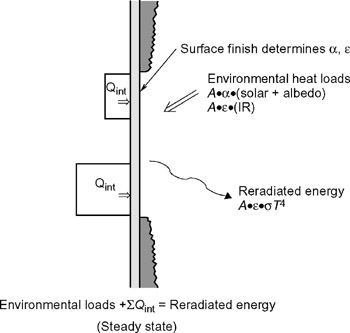
Spacecraft waste heat is ultimately rejected to space by radiator surfaces. Radiators occur in several different forms, such as spacecraft structural panels, flat-plate radiators mounted to the side of the spacecraft, and panels deployed after the spacecraft is on orbit. Whatever the configuration, all radiators reject heat by infrared (IR) radiation from their surfaces. The radiating power depends on the surface's emittance and temperature. The radiator must reject both the spacecraft waste heat plus any radiant-heat loads from the environment or other spacecraft surfaces that are absorbed by the radiator, as shown in Fig. 6.1. Most radiators are therefore given surface finishes with high IR emittance ( ? > 0.8) to maximize heat rejection and low solar absorptance ( ? < 0.2) to limit heat loads from the sun. Typical finishes, discussed in more detail in Chapter 4, include quartz mirrors, silvered or aluminized Teflon, and white paint.


Figure 6.1: ( Fig. 4.1, reproduced here for your convenience.) Radiator energy balance. Environmental loads + ?Q int = reradiated energy (steady state, no external blockage).

The radiating power of a radiator is a strong function of temperature. The total heat leaving a radiator surface is given by the simple expression

(6.1)

where A is surface area, ? is emittance, and ? is the Stefan-Boltzmann constant (5.669 10 ?8 W/m 2 K 4), and T is absolute temperature (K).

The

UNLIMITED FREE
ACCESS
TO THE WORLD'S BEST IDEAS

SUBMIT
Already a GlobalSpec user? Log in.

This is embarrasing...

An error occurred while processing the form. Please try again in a few minutes.

Customize Your GlobalSpec Experience

Category: Hydronic Radiators
Finish!
Privacy Policy

This is embarrasing...

An error occurred while processing the form. Please try again in a few minutes.