Spacecraft Thermal Control Handbook, VolumeI: Fundamentals Technologies

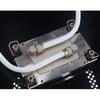
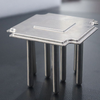
Heat pipes use a closed two-phase liquid-flow cycle with an evaporator and a condenser to transport relatively large quantities of heat from one location to another without electrical power. A heat pipe can create isothermal surfaces; as a thermal "transformer," it can change the flux density of a heat flow; and it can function in various ways as a thermal-control device. One-way (diode) heat pipes have been tested and flown, as have variable-conductance heat pipes (VCHPs), which maintain a constant-temperature evaporator surface under varying load conditions. Because the driving mechanism in a heat pipe is capillary pumping, a relatively weak force that is provided by a wick, the pipe may be susceptible to severe performance degradation when operating in a gravitational field. Planning is therefore needed to facilitate the ground testing of systems that include heat pipes.
Consider a simple horizontal heat pipe in equilibrium with an isothermal environment. The liquid in the wick and the vapor in the vapor space are at saturation. If heat is applied to the evaporator, raising its temperature, liquid in the wick evaporates (removing some of the added heat), which depresses the meniscus in the evaporator because less liquid remains there. This process also raises the local vapor pressure, because that pressure must be in saturation with the heated liquid in the wick.
The difference between the...