Spacecraft Thermal Control Handbook, VolumeI: Fundamentals Technologies

Heat pipes are fluid-filled, wicked heat-transport components often used in spacecraft thermal control. They utilize capillary forces and latent heat in their operation, and their mechanical and thermal interfaces are an important input to the thermal design. They are discussed in more detail in Chapter 14.
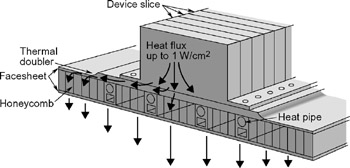
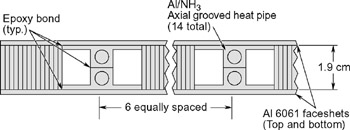
Typical heat pipe payload integrations are shown in Figs. 8.31 through 8.33. Figs. 8.31 and 8.32 show schematics of heat pipes embedded into honeycomb panels. Such panels are constructed of high-thermal-conductivity facesheets and stiff honeycomb core. They can be utilized in the spacecraft interior or as direct radiators on the exterior. The facesheets withstand the bending loads and act as lateral conductance fins for the mounted unit (Fig. 8.31), while the core resists shear loads, provides stiffness, retains the component fastener, and provides low-level transverse conductance. The heat pipes are bonded to the interior surfaces of the facesheets; they provide lateral thermal conductance and, in some configurations (Fig. 8.32), transverse conductance by virtue of the casing. The heat pipes of Fig. 8.32 are bonded together and provide one-for-one redundancy.
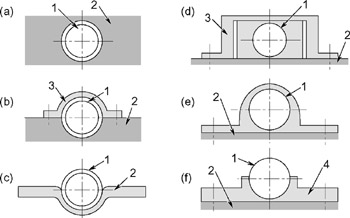
Figure 8.33 shows six heat-pipe integration configurations. Configuration (a) is "buried" within the mounting. Mechanically the heat pipe is attached by threading or by virtue of a tapered...