L. Bledjian,
The Aerospace Corporation, El Segundo, California.
D. V. Hale,
Lockheed Martin, Huntsville, Alabama.
M. J. Hoover,
Lockheed Martin, Huntsville, Alabama.
M. J. O'Neill,
Lockheed Martin, Huntsville, Alabama.
Phase-Change-Material Applications
The use of phase-change materials (PCMs) for thermal control is not new; consider the use of the icebox to store perishable foods before the development of efficient, inexpensive, active refrigeration systems. Recently, however, research and development in PCM technology has resulted in novel applications for both terrestrial and space environments.
The numerous electrical components on a spacecraft present thermal-control challenges. High-power-dissipating components must be prevented from over-heating, without the earthbound benefits of free convection to the air or conduction to a cold plate. Conversely, components that are only activated occasionally must be prevented from cooling to temperatures below operational level, and the lack of atmosphere precludes normal convective methods of thermal control. Such components present an ideal application for PCM thermal control.
The simplest form of PCM thermal control for electronic components is the one that is used for short-duty-cycle components in launch or reentry vehicles. Although such components are used only once, they generate large quantities of heat that must be removed so that they will not overheat and subsequently fail. A PCM can thermally protect such a component, as shown in Fig. 11.1. The generated heat is absorbed via latent heat of fusion by the PCM without an appreciable temperature rise of the component. This kind of system is totally passive and very reliable.
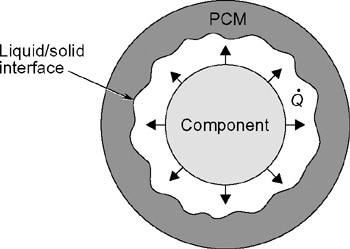 Figure 11.1: PCM...
Copyright The Aerospace Corporation 2002 under license agreement with Books24x7


 TABLE OF CONTENTS