D. G. Gilmore,
The Aerospace Corporation, El Segundo, California.
J. C. Lyra,
Jet Propulsion Laboratory, California Institute of Technology, Pasadena, California.
J. W. Stultz,
Jet Propulsion Laboratory, California Institute of Technology, Pasadena, California.
Introduction
Under ideal circumstances, thermal control of a satellite or component would be achieved only through passive techniques, such as the use of surface finishes. Unfortunately, though, variations in environment and component heat-generation rates, along with the degradation of surface finishes over time, can drive temperature variations in a passive design to ranges larger than some components can withstand. Heaters therefore are sometimes required in a thermal design to protect components under cold-case environmental conditions or to make up for heat that is not dissipated when an electronics box is turned off. Heaters may also be used with thermostats or solid-state controllers to provide precise temperature control of a particular component. Another common use for heaters is to warm up components to their minimum operating temperatures before the components are turned on. Each of these three applications is described in this chapter.
Heater Types
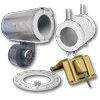
The most common type of heater used on spacecraft is the patch heater, several of which appear in Fig. 7.1. It consists of an electrical-resistance element sandwiched between two sheets of flexible electrically insulating material, such as Kapton. The patch heater may contain either a single circuit or multiple circuits, depending on whether or not redundancy is required within it. Redundancy is generally required on spacecraft systems, because heater circuits can fail. Sometimes the...
Copyright The Aerospace Corporation 2002 under license agreement with Books24x7


 TABLE OF CONTENTS