Target Detection by Marine Radar

Chapter 1: Introduction

'It is on men that safety at sea depends and they cannot make a greater mistake than to suppose that machines can do all their work for them.'
Mr Justice Cairns, giving judgement in the Trentbank-Fogo case, 1967, quoted in A. N. Cockcroft and J. N. F. Lameijer, A Guide to the Collision Avoidance Rules , Stanford Maritime, London, 1976, p. 39

1.1 Purpose and Scope

This introductory chapter explains the book's aims and methods, introduces the persons who operate radar, gives a brief historical background and outlines the regulatory framework under which marine radar is used.

1.1.1 Purpose

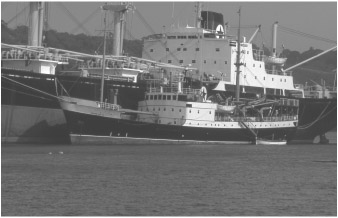
The art, science and skill of the navigator is to get a ship from A to B without hitting anything. Ships come in many shapes and sizes, Figure 1.1, from pleasure yachts to half-million tonne tankers. A and B may be berths in harbours, but B may be a pilot cutter or a shoal of fish. Among the things to be avoided are coastal features, other vessels, heavy flotsam and ice. Radar is an essential tool used to locate these hazards, assisting the navigator to make timely manoeuvre decisions.


Figure 1.1: Ships come in all sizes

Radar, an acronym for radio detection and ranging, detects objects of interest by transmitting radio signals in known directions from a narrow-beam antenna or scanner which scans the horizon, then timing the instants of reception of returned echoes from these 'targets'. (This Second World War term dates from development of radar for gunnery control and...

UNLIMITED FREE
ACCESS
TO THE WORLD'S BEST IDEAS

SUBMIT
Already a GlobalSpec user? Log in.

This is embarrasing...

An error occurred while processing the form. Please try again in a few minutes.

Customize Your GlobalSpec Experience

Category: Automatic Identification Systems (AIS)
Finish!
Privacy Policy

This is embarrasing...

An error occurred while processing the form. Please try again in a few minutes.