Target Detection by Marine Radar

12.8: Radar Diversity

12.8 Radar Diversity

12.8.1 Principles

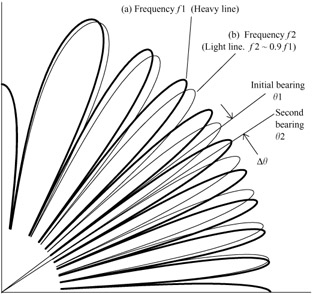
Chapter 6, Section 6.4.4, touched on the possibility of mitigating point target multipath null depths to a pair of scanners by attention to heights and operating frequencies. Chapter 7, Section 7.10, showed the resultant RCS of a pair of reflectors to be critically dependent on angle of look and on radar frequency. Figure 12.33(a) depicts one quadrant of the polar diagram of a rudimentary two-point-element target similar to Section 7.10.2, Figure 7.15(f). Initially it might be viewed on bearing ?1, where there is a null in the pattern. Shifting radar bearing a few degrees to ?2 yields a peak. Similarly, shifting frequency a few per cent from f1 to f2 without shift of bearing also moves RCS between a peak and a null. Clearly, viewing at diverse angles or by diverse frequencies partly fills nulls and reduces the probability that a target composed of several reflecting elements will continue to exhibit an extreme of RCS. Also the probability that two uncorrelated observations both yield an extreme value is less than for either radar alone. The probability distribution of RCS becomes more concentrated around the mean, moving part-way to Case 0, making detection possible at lower SNR.


Figure 12.33: Bearing and frequency diversity. Part of target polar diagram at differing frequencies. Two equal reflecting elements; based on Figure 7.15(f)

Diversity also decorrelates precipitation clutter and partly decorrelates sea clutter, because the samples differ. Therefore improved detection in noise or clutter is obtained...

UNLIMITED FREE
ACCESS
TO THE WORLD'S BEST IDEAS

SUBMIT
Already a GlobalSpec user? Log in.

This is embarrasing...

An error occurred while processing the form. Please try again in a few minutes.

Customize Your GlobalSpec Experience

Category: Active Band Reject Filters
Finish!
Privacy Policy

This is embarrasing...

An error occurred while processing the form. Please try again in a few minutes.