Target Detection by Marine Radar

In non-coherent systems, calculation of detection in precipitation clutter is exactly as for detection in noise because they share the same distribution, initially Gaussian. Clutter power (W, not dBW) is merely added to the noise power in the equations. Signal to (noise plus clutter) power ratio can directly replace numerical signal to noise ratio in the equations for detection in noise, explaining why signal to noise-plus-clutter ratio is so often abbreviated to SNR. To retain the desired P FA in clutter, threshold k has to be raised to prevent declaration of clutter returns as targets. This reduces P D and explains why clutter inevitably impairs target detectability, even when a clever signal processing system keeps the display screen clear. The PDF is as Figure 12.11 and Eq. (12.5b) of Section 12.3.3, when the receiver is non-coherent, otherwise Figure 12.6 and Eq. (12.4a) of Section 12.3.3 apply.
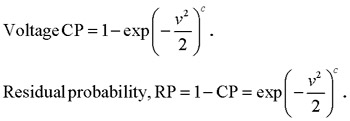
Chapter 11, Section 11.7.4, showed that sea clutter may approximate Weibull distribution with shape parameter c. Land and ice clutters also approximate this distribution. The following puts Eq. (12.5a) into Weibull form to align with Eq. (11.18). It is normalised by putting ? = 1 and restated in terms of instantaneous voltage, v, where ? = v 2/2.
Using subscript c to indicate conditions at shape parameter c and setting threshold k c at the value of v which...