Target Detection by Marine Radar

'Power corrupts, but lack of power corrupts absolutely.'
A Parody of Lord Acton
This chapter outlines radar operation in general terms, and then describes the transmission systems of the relatively large radars used in deep-sea ships, vessel traffic service (VTS) systems and firing-range surveillance. Receiving systems are described in Chapter 3. Chapter 4 onwards detail the various facets of the detection problem, including quantitative analysis.
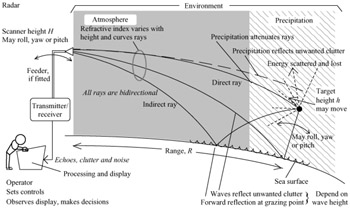
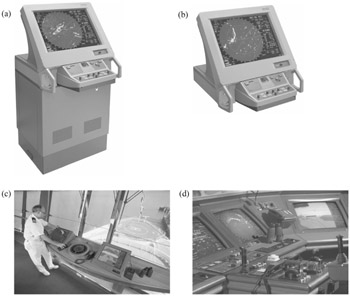
Figure 2.1 shows the whole radar/target/environment system. A person is studying the traffic situation at the display console. No mere passive observer, this officer adjusts the radar controls to optimise the display of targets of most current importance. Stressing this interaction, we refer to the person as the operator. The display itself, sometimes still called the indicator or scope, with associated controls forms the human-machine interface (HMI) between the radar and operator and one task of this book is to consider how the machine can best help the human perceive the targets - apprehend them within the mind to gain situational awareness. Figure 2.2(a) shows a traditional deck-mounted console, while Figures 2.2(b) and (c) depict alternative formats suited to building into operator workstations.