Theory of Beam Columns: In-Plane Behavior and Design, Volume 1

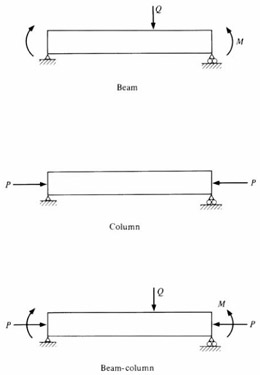
Many engineering structures are made up in some way or another of a number of bars jointed together by bolts, rivets or welds. Typical examples are building frames, bridge trusses, cranes, ships' hulls and aircraft structures. The number of bars which go to make these structures can be very large. Among these structures, building frames and bridge trusses, which are composed of straight elements, are the main concern of this book. Since bars are used as basic elements of so many different structures, they are called by quite different names depending upon their function and upon the type of loading carried. For elements of frameworks, they are generally categorized into tension members or ties, beams, columns, and beam-columns as shown in Fig. 1.1.
A tension member or a tie is a member where there is axial tension alone or tension predominates. A tie is generally a very slender member unable to lake more than negligible compression, A beam is a member where bending moments predominate. A column is a member where axial compression predominates. A beam-column is a member where both bending moment and compression are important, A beam-column is a general structural element containing beam and column as its special cases.
All structures deflect under loading, but in general the effect of this upon the over-all geometry can be ignored. In the particular case of columns, and beam-columns, however,...