Theory of Beam Columns: In-Plane Behavior and Design, Volume 1
Chapter 6: Plastic Buckling of Columns

6.1 INTRODUCTION

The problem of the design of columns should really be approached from the stand-point of the study of the behavior of initially imperfect and/or laterally loaded columns throughout the entire range of loading up to ultimate load (deflection approach). We will learn, however, from discussions and examples in the following chapter that any rigorous elastic-plastic analysis which attempts to cover the behavior of such columns is destined to be complex, and the labor involved in the numerical calculations limits its practical use. In this chapter, we shall try to obtain in a direct manner the maximum load-carrying capacity of an axially loaded plastic column by applying the eigenvalue or buckling approach to an idealized column just as we did for the case of a linear elastic material (Sec. 3.5, Chap. 3). It should be kept in mind, however, that this buckling approach as applied to a plastic column may or may not be of relevance to a real column subjected to a different loading history or conditions. Comparison always must be made with the many aspects of physical reality in order to ascertain the validity of such a mathematical model as a substitution of a real column.

In the following, the idealized column implies the following assumptions:

  1. The column is perfectly straight.

  2. The compressive load is static and is applied along the center line.

  3. The material is homogeneous and free of initial stress.

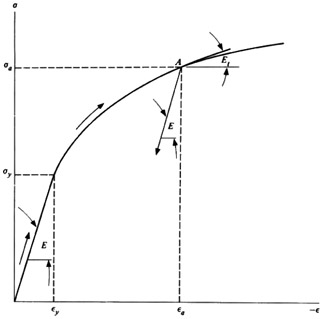
  4. Stress-strain relations follow the curve shown in Fig. 6.1.


Figure 6.1: Stress-strain relationships

UNLIMITED FREE
ACCESS
TO THE WORLD'S BEST IDEAS

SUBMIT
Already a GlobalSpec user? Log in.

This is embarrasing...

An error occurred while processing the form. Please try again in a few minutes.

Customize Your GlobalSpec Experience

Category: Columns
Finish!
Privacy Policy

This is embarrasing...

An error occurred while processing the form. Please try again in a few minutes.