Theory of Beam Columns: In-Plane Behavior and Design, Volume 1
3.8: SUMMARY

3.8 SUMMARY

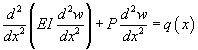
The governing differential equation of a column or a beam-column is

(3.155)

The general solution has the form

(3.156)

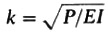
in which represents the axial force P and f( x) is a particular solution due to the lateral load q( x). The boundary conditions to be used for the determination of the integration constants A, B, C and D are related to the following relationships:

(3.157)

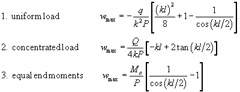
The maximum deflection at the mid-span for three typical simply supported beam-columns are:

(3.158)

The deflections are linear to the lateral load or end moments but not to the axial force P. In case of no lateral loads nor end moments; zero deflection w = 0 is the only solution from Eq. (3.158), In this case, however, the system becomes an axially loaded ideal column and a specific value of the axial force, k = = ?/ l, the right hand side of Eq. (3.158) becomes infinite. This is the buckling load of a column. Buckling load is solved as the lowest eigenvalue. Generally, buckling load for a column is given by

(3.159)

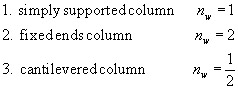
in which n w is number of half waves contained in the buckling mode, for example:

(3.160)

Stability of a system can be checked by variation in the potential energy V[ w] which consists of strain energy U[ w] and external work done W[ w] i.e..

(3.161)

UNLIMITED FREE
ACCESS
TO THE WORLD'S BEST IDEAS

SUBMIT
Already a GlobalSpec user? Log in.

This is embarrasing...

An error occurred while processing the form. Please try again in a few minutes.

Customize Your GlobalSpec Experience

Category: Constant Force Springs
Finish!
Privacy Policy

This is embarrasing...

An error occurred while processing the form. Please try again in a few minutes.