Theory of Beam Columns: In-Plane Behavior and Design, Volume 1
Columns subjected to lateral loads or end moments in addition to axial compression are categorized as beam-columns. The lateral loads or end moments cause deflection which is further amplified by the axial compression. The main result of the above discussion is the elastic beam-column equation (3.19). The general solutions are given by Eq. (3.22), The problem here is to find the function f( x) which depends only on the lateral loading and the constants A, B, C, D that satisfy the boundary conditions at the clamped, free, or simply supported ends.
As an example. consider a beam-column which is subjected to uniform load q as well as an axial compression P as shown in Fig. 3.9(a). The beam-column has length l and bending rigidity EI which is assumed to be constant along the length.
The governing equation (3.19) is
| (3.23) | |
and the general solution is
| (3.24) | |
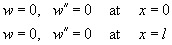
The four constants A, B, C and D are determined from the four boundary conditions,
| (3.25) | |
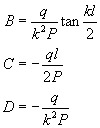
Actual calculation of Eq. (3.22) gives
| (3.26) | |
Thus the deflection equation (3.24) yields
| (3.27) | |
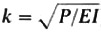
It is known from the above expression that the deflection is linear to the lateral load q but not to the axial compression P (or
). The deflection pattern also changes as the axial force changes.
The maximum deflection ? occurs...