Theory of Beam Columns: In-Plane Behavior and Design, Volume 1
As was seen in Sec. 3.6, the stability condition for an equilibrium system is
| (3.116) | |
for all admissible displacement field w( x), in which equality symbol implies the stability limit. The increment in potential energy ? 2 V[ w] is the summation of internal strain energy ? 2 U[ w] and the external work done ? 2 W[ w, P]. Further the latter is usually proportional to the external force P
| (3.117) | |
Thus the condition for the determination of stability limit load is
| (3.118) | |
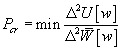
From which the critical load is obtained
| (3.119) | |
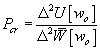
If w o( x) is the solution which gives the right hand side the minimum value then
| (3.120) | |
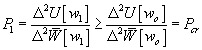
and for any other admissible displacement function w 1( x), which satisfies the kinematic or geometric boundary conditions,
| (3.121) | |
This implies that an arbitrarily assumed displacement function w 1( x) which satisfies the kinematic or geometric boundary conditions gives a load P 1 which is always greater than the exact solution P cr. It is clear from the above discussion that the closer the prescribed function w 1 is to the exact one w o, the closer the load P 1 gets to the exact solution P cr.
Considering the case of a simple column as shown in Fig. 3.15(a), and using the compressed but undeflected state as reference position...