Tolley's Practical Risk Assessment Handbook, 5th Edition
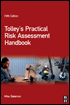
Containing numerous checklists, forms and worked examples for a variety of hazards and industries, this book demystifies the risk assessment process and how it relates to UK legislation.
 TABLE OF CONTENTS
 The risks associated with exposure to noise have been understood for many years. HM Factory Inspectorate (a forerunner of the HSE) published its booklet Noise and the Worker in 1963 and the courts have deemed that employers should have been aware of the risks since that date and been taking action to control them. However, employers were slow to move and as a result there have been many successful compensation claims for occupational deafness and many workers are also in receipt of government disablement benefit in respect of noise-induced hearing loss.
Occupational deafness has occurred in many industries mining, shipbuilding, engineering, textiles, construction and the wood trades being some of the more common. However, there was no specific legislation dealing with noise until 1990 when the Noise at Work Regulations 1989 came into operation. These Regulations were replaced by the Control of Noise at Work Regulations 2005 which came into operation on 6 April 2006, although there were transitional provisions for some work sectors. At the heart of the Regulations is a requirement for employers to make an assessment of the risks from noise.
Hearing takes place through the action of sound waves on the eardrum. The eardrum vibrates, activating the bones of the inner ear, which in turn exert pressure on the cochlea, a snail-shaped organ containing a liquid. Motion of liquid within the cochlea is detected by tiny hair cells which transmit sound...