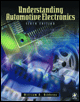
Understanding Automotive Electronics, Sixth Edition
Generally speaking, electronic systems function to control, measure, or communicate. Automotive electronic systems fall generally into these same three application areas. The major categories of automotive electronic systems include
Engine/power train control
Ride/handling control
Cruise control
Braking/traction control
Instrumentation (instrument panel)
Power steering control
Occupant protection
Entertainment
Comfort control
Cellular phones
Historically, automotive electronics was confined primarily to communications, with the incorporation of AM radios and police-car two-way radio systems. These remained the only significant electronics applications throughout the 1930s and 1940s. This was an era in which vacuum tubes were the only important active electronic devices.
The development of solid-state electronics, beginning with the transistor in the late 1940s and evolving through high-performance integrated circuits, provided a technology that was compatible with the evolution of other automotive electronic systems such as ignition systems, turn signals, instrumentation, and a variety of other automotive subsystems. Perhaps the biggest evolutionary jump occurred in the 1970s with the advent of electronic fuel control systems, a step motivated primarily by government regulations (as we will show later). Since then the evolution of electronic systems in automobiles has seen spectacular growth, such that automotive electronics is now estimated to account for 10% to 25% of the cost of the vehicle, depending on feature content.
This book will discuss the application of electronics in automobiles, from the standpoint of electronic systems and subsystems. In a sense, the systems approach to describing automotive electronics...