Understanding Automotive Electronics, Sixth Edition

A microcomputer stores information on a temporary basis within the CPU registers. Information is transferred between the CPU registers and the memory or input/ output sections by means of one or more sets of multiple wires; each set is called a bus.
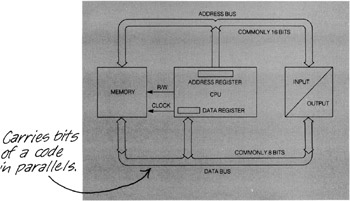
Recall the basic computer block diagram of Figure 4.l. The central processing unit (CPU) requests information from memory (or from an input device) by generating the address for the data in memory. The address with all its bits is stored in the CPU as a binary number in a temporary data latch type memory called a register (see Chapter 3). The outputs of the register are sent at the same time over multiple wires to the computer memory and peripherals.
As shown in Figure 4.2, the group of wires that carries the address is called the address bus. (The word bus refers to one or more wires that is a common path to and from various components in the computer.) The address register used in many microcomputers holds 32 bits; these bits enable the CPU to access 2 32 memory locations. In a microcomputer, each memory location usually contains multiples of 8 bits of data. A group of 8 bits is called a byte and a group of 16 bits is sometimes called a word.
Information is sent to or received from memory locations and input/ output devices via the bidirectional data bus.
Data...