Understanding Automotive Electronics, Sixth Edition
INSTRUMENTATION APPLICATIONS OF MICROCOMPUTERS

Microcomputers can convert the nonlinear output voltage of some sensors into a linear voltage representation. The sensor output voltage is used to look up the corresponding linear value stored in a table.

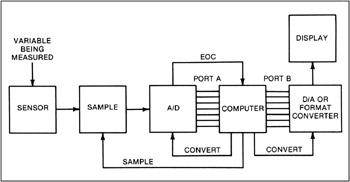
In instrumentation applications of microcomputers, the signal processing operations are performed numerically under program control. The block diagram of a typical computer-based instrument is depicted in Figure 4.23. In this example instrument, an analog sensor provides a continuous-time voltage, V o, that is proportional to the quantity being measured. The continuous-time voltage is sampled at times determined by the computer. The sampled analog voltage is then converted to digital format (e.g., 8 to 16 bits) using an ADC. The digital data are connected to port A of the I/O device of the computer to be read into memory.


Figure 4.23: Typical Automotive Instrumentation Architecture

The ADC generates a signal when the conversion from analog to digital is completed. This signal is normally termed end of conversion (EOC). The EOC signal provides an interrupt signaling the computer that data are ready.

The signal processing to be performed is expressed as a set of operations that is to be performed by the microprocessor on the data. These operations are termed the algorithm for the signal processing operation. The algorithm is converted to a set of specific computer operations that becomes the program for the signal processing. After the signal processing is completed, the result is ready to be sent to the display device.

UNLIMITED FREE
ACCESS
TO THE WORLD'S BEST IDEAS

SUBMIT
Already a GlobalSpec user? Log in.

This is embarrasing...

An error occurred while processing the form. Please try again in a few minutes.

Customize Your GlobalSpec Experience

Category: Signal Conditioners
Finish!
Privacy Policy

This is embarrasing...

An error occurred while processing the form. Please try again in a few minutes.