Understanding Automotive Electronics, Sixth Edition

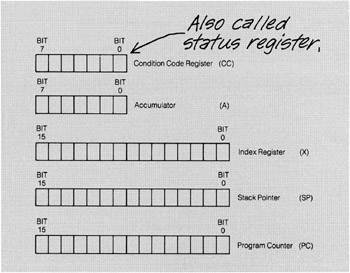
The programmer (the person who writes the sequences of instructions for a particular task) uses a different model (a programming model) of the microprocessor used in a system than does the hardware designer. This model shows the programmer which registers in the CPU are available for program use, and what function the registers perform. By way of illustration Figure 4.4 shows a programming model microprocessor for a typical 8-bit (now obsolete) microcomputer. The computer has two 8-bit registers and three 16-bit registers. The 16-bit registers are discussed later; the 8-bit registers are discussed here.
The accumulator register, also called the A register, is used for arithmetic and logical operations.
One of the 8-bit registers is an accumulator, a general-purpose register that is used for arithmetic and logical operations. The accumulator can be loaded with data from a memory location, or its data can be stored in a memory location. The number held in the accumulator can be added to, subtracted from, or compared with another number from memory. The accumulator is the basic work register of a computer. It is commonly called the A register.
The condition code register, also called the status register, indicates certain conditions that take place during various accumulator operations.
The other 8-bit register, the condition code (CC) register (also called status register), indicates or flags certain conditions that occur during accumulator operations. Rules are...