Understanding SQL & Java Together: A Guide to SQLJ, JDBC, and Related Technologies
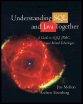
A comprehensive guide to how the marriage of SQL and Java is forging a new era in object-oriented databases.
 TABLE OF CONTENTS
 In this chapter we're going to discuss SQLJ Part 1. SQLJ Part 1 allows you to bring Java code into the DBMS and use it to implement stored routines: procedures and functions. The naming of this part might suggest that there is some relationship with SQLJ Part 0. Other than the fact that the same group of companies worked on it, however, the two parts are quite separate.
SQLJ Part 1 was brought in to the SQLJ group of companies by Sybase, and the Sybase representative acted as its editor while the group made corrections and enhancements to it. In April 1999 it was submitted to NCITS for Fast Track processing, and in September 1999 it was adopted as NCITS 331.1-1999. [1]
Because SQLJ Part 1 enables an association to be created between Java methods and SQL routines, we will begin this chapter by reviewing SQL routines. We'll discuss how JAR files are brought into a database, how SQL routines are associated with Java methods, and how the JAR files in a database can be altered and dropped. Finally, we'll end the chapter by discussing a product that has begun to implement some of this technology.
This section will provide a very brief review of some of the features of SQL Part 4: Persistent Stored Modules (SQL/PSM). Jim Melton has, as you are probably aware, already written a very thorough treatment of this material. [2]
SQL-86 defined externally-invoked procedures procedures that were defined...