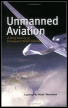
Unmanned Aviation: A Brief History of Unmanned Aerial Vehicles
SUMMARY

Man's presence in the air has been gradually extended through a series of technological advancements and new piloting skills. When the amount of fuel carried was the original limiting factor, aviators developed the technique of aerial refueling, tentatively in the 1920s and then with ubiquity by the 1950s. The next barrier to long flight, oil consumption, fell away as reciprocating engines gave way to turbine engines. The first nonstop, around-the- world flight by the B-50 (Lucky Lady II) in 1949 (with extra crewmen onboard) capitalized on the downfall of this barrier while also making a pointed demonstration that anyone was now reachable in one flight. The final barrier became man himself, both psychologically to long-duration flights and physiologically to high-altitude missions. When new missions, military and scientific, emerged that dictated aircraft fly even higher and longer, man, the aviator, began relinquishing his role to robotic aircraft.

Endurance UAVs introduced not just new technologies, such as solar- powered flight, but new operational paradigms as well, such as the concept of a pseudosatellite (or "eternal airplane"). Predator and Gnat not only introduced a new capability (real time surveillance) to military commanders but also served as ambassadors to former communist bloc countries (Albania, Croatia, Hungary), whose introduction to military cooperation with the United States after the fall of the Berlin Wall was via these early endurance UAV deployments.

UNLIMITED FREE
ACCESS
TO THE WORLD'S BEST IDEAS

SUBMIT
Already a GlobalSpec user? Log in.

This is embarrasing...

An error occurred while processing the form. Please try again in a few minutes.

Customize Your GlobalSpec Experience

Category: Flight Displays
Finish!
Privacy Policy

This is embarrasing...

An error occurred while processing the form. Please try again in a few minutes.