Unmanned Aviation: A Brief History of Unmanned Aerial Vehicles
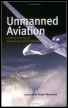
Chapter 14: Unfueled and Unmanned

OVERVIEW

The Sun continuously rains energy at the rate of 100 W per ft 2 on the Earth. A modest size aircraft typically has a wing area of 100 ft 2. Such aircraft require about 250 500 W for each knot of airspeed flown.

In the early 1970s, Robert Boucher put these three facts together and decided to build a solar-powered aircraft using the relatively new technology of photovoltaic (PV) cells, then used to power satellites and space probes. He imagined an aircraft with the ultimate endurance unlimited. In 1974, Lockheed, working under a DARPA contract, gave him a subcontract to turn that concept into reality. Within months, with the help of his twin brother Roland, he had built the Sunrise I, the world's first fuelless-powered airplane. Its 32-ft wing had a large patch of 1000 solar cells across its upper surface that could provide up to 450 W. PV cells of that day only had efficiencies of 10 15%, were inflexible, and were expensive. The 26-lb Sunrise I made the world's first solar-powered flight from Bicycle Lake, a dry lakebed in California's Mojave Desert, on 4 November 1974. Its PV cells were the sole power source for its two ferrite electric motors; no backup batteries were carried. It made a number of successful flights before being damaged in a wind storm that spring.

Boucher received an immediate follow-on contract to build a second solar airplane in June, which was ready for flight within three months. On 27 September...

UNLIMITED FREE
ACCESS
TO THE WORLD'S BEST IDEAS

SUBMIT
Already a GlobalSpec user? Log in.

This is embarrasing...

An error occurred while processing the form. Please try again in a few minutes.

Customize Your GlobalSpec Experience

Category: PV Ribbon
Finish!
Privacy Policy

This is embarrasing...

An error occurred while processing the form. Please try again in a few minutes.