The VoiceXML Handbook: Understanding and Building the Phone-Enabled Web
This book explains the Web, telephony, and VoiceXML, and puts them together to make your Web ring.
 TABLE OF CONTENTS
 The generic term Computer Telephony (CT) is used to refer to any situation where a computer is involved in handling a telephone call. Today, that means almost every call you make: most switches on the public telephone network are controlled by computers, often running the Unix operating system.
Usually, "Computer Telephony" is reserved for configurations where a general-purpose computer is used. Many enterprise telephone systems (PBXs) are controlled by microprocessors but, unless they are based on a general-purpose architecture such as a PC, these are generally considered embedded systems rather than CT systems.
While Computer Telephony Integration (CTI) may sound just as generic as "Computer Telephony", it is usually used to refer to a more specific situation where a switch is controlled by a physically separate computer. The computer and switch are connected via a CTI link, which could be an RS-232 serial line, Ethernet or other type of network connection.
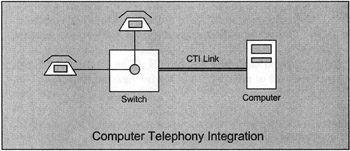
The CTI link carries a) messages from the switch to the computer, and b) commands from the computer to the switch.
Typical messages notify the computer of incoming calls and of caller hang-ups.
Typical commands instruct the switch to answer a call, transfer a call to an outside line or a local extension and to set up a conference with two or more parties.
Switches which support CTI are sometimes called smart switches or programmable switches.
A voice modem is a single-line PC data modem which has...